Example of use
This page shows how a Harmonix application is put together. It uses the Harmonix demo shell, the small shell that Harmonix provides to develop and try plugins.
The parts
There are three parts:
- Harmonix (
@uxland/harmonix). The core that loads the plugins, gives each one an API and manages the regions. - The shell. The main application. It defines a skeleton with regions where plugins inject Web Components. Each application builds its own shell, with its own layout and services.
- The plugins. Packages developed by other teams. They are built and published, usually to a Plugin Store, and the shell loads them.
The shell
The demo shell has three regions: a header, a side menu and the main content. On its own, the shell is an empty skeleton. Before any plugin starts, its DOM looks like this:
<harmonix-demo-shell>
  <header>
    <div id="header-region"></div>
  </header>
  <nav>
    <div id="side-menu-region"></div>
  </nav>
  <main>
    <div id="main-region"></div>
  </main>
</harmonix-demo-shell>
A plugin
Each plugin is built and bundled into a JavaScript file, for example plugin1-1.2.0.js.
The file is an ES module that exports two functions:
initialize(api)starts the plugin. The shell calls it with an API object. Through the API the plugin registers its views in the regions (header, side menu, main) and publishes or listens to events from other plugins. Each shell can add more services to its API, such as an HTTP client or notifications.dispose(api)stops the plugin. It must undo everythinginitializedid.
import type { DemoShellApi } from "@uxland/harmonix-demo-shell";

export const initialize = async (api: DemoShellApi) => {
  const { regions } = api.regionManager;

  // Register Web Components in the regions of the shell
  await api.regionManager.registerView(regions.header, { id: "header", factory: async () => new Plugin1HeaderWebComponent() });
  await api.regionManager.registerView(regions.sideMenu, { id: "menu", factory: async () => new Plugin1MenuWebComponent() });
  await api.regionManager.registerView(regions.main, { id: "main", factory: async () => new Plugin1MainWebComponent() });

  // Tell the other plugins that this one is ready
  await api.broker.publish("plugin1:ready", { pluginId: api.pluginInfo.pluginId });
};

export const dispose = async (api: DemoShellApi) => {
  const { regions } = api.regionManager;
  await api.regionManager.removeView(regions.header, "header");
  await api.regionManager.removeView(regions.sideMenu, "menu");
  await api.regionManager.removeView(regions.main, "main");
};
Plugin1HeaderWebComponent and the others are custom elements defined by the plugin.
The shell with plugins
Once the plugins have started, the skeleton is filled with their Web Components. With two plugins, the DOM looks like this:
<harmonix-demo-shell>
  <header>
    <div id="header-region">
      <plugin1-header><span>I'm Plugin 1</span></plugin1-header>
      <plugin2-header><span>I'm Plugin 2</span></plugin2-header>
    </div>
  </header>
  <nav>
    <div id="side-menu-region">
      <plugin1-menu><span>Go to Plugin 1</span></plugin1-menu>
      <plugin2-menu><span>Go to Plugin 2</span></plugin2-menu>
    </div>
  </nav>
  <main>
    <div id="main-region">
      <plugin1-main>
        <div class="box">Plugin 1 Box main</div>
      </plugin1-main>
      <plugin2-main hidden>
        <div class="box">Plugin 2 Box main</div>
      </plugin2-main>
    </div>
  </main>
</harmonix-demo-shell>
The header and the side menu are multiple-active regions: all their views are shown at once. The main region is single-active: only one view is shown at a time. When all the plugins have started, if no plugin has activated a main view, the demo shell activates the first one registered. The other view stays hidden until a menu item activates it.
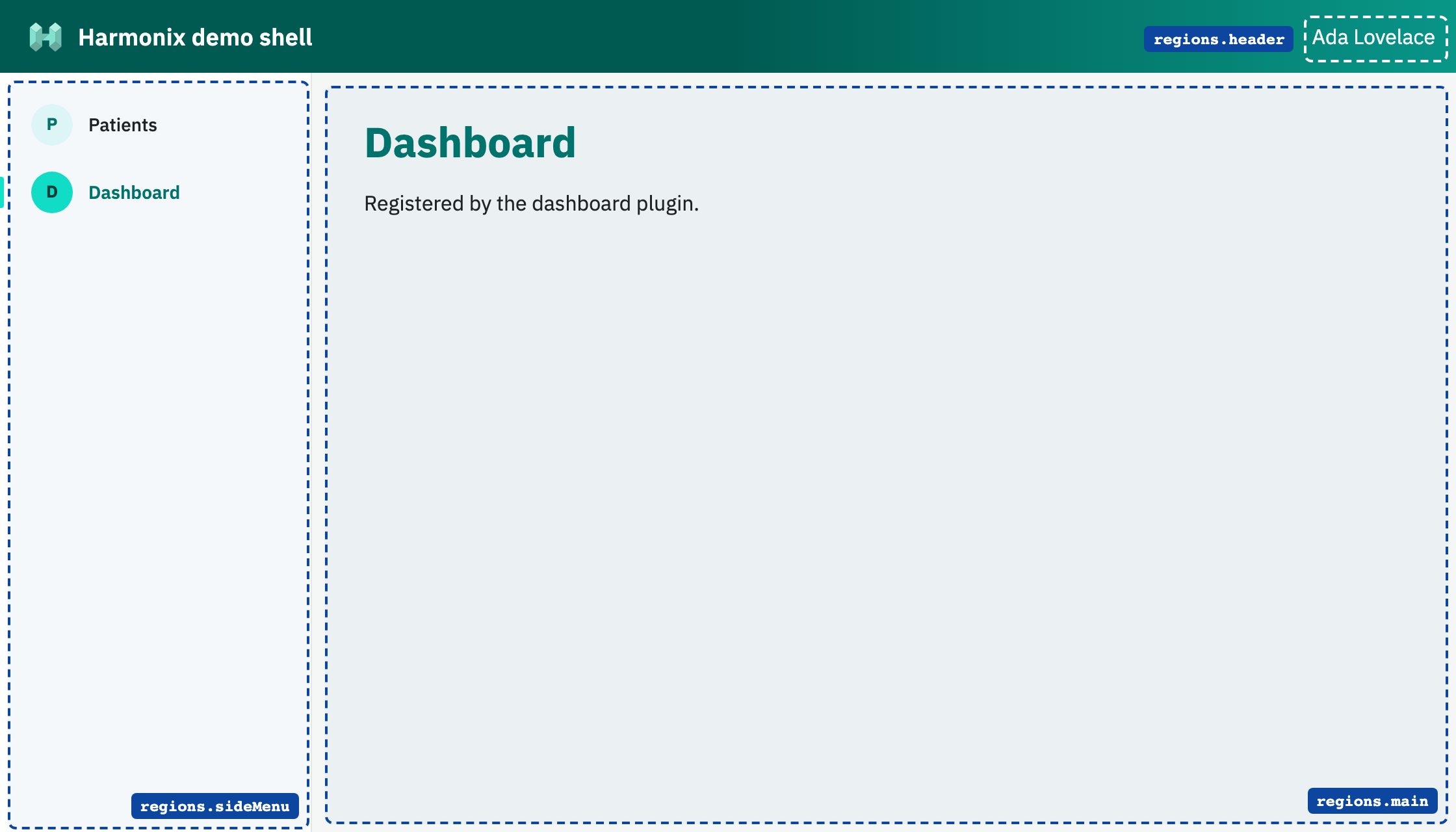
To develop a plugin, teams do not need the final application. The plugin creator gives them a project that runs the plugin in the demo shell, so they can work on their own and see how the plugin will look.